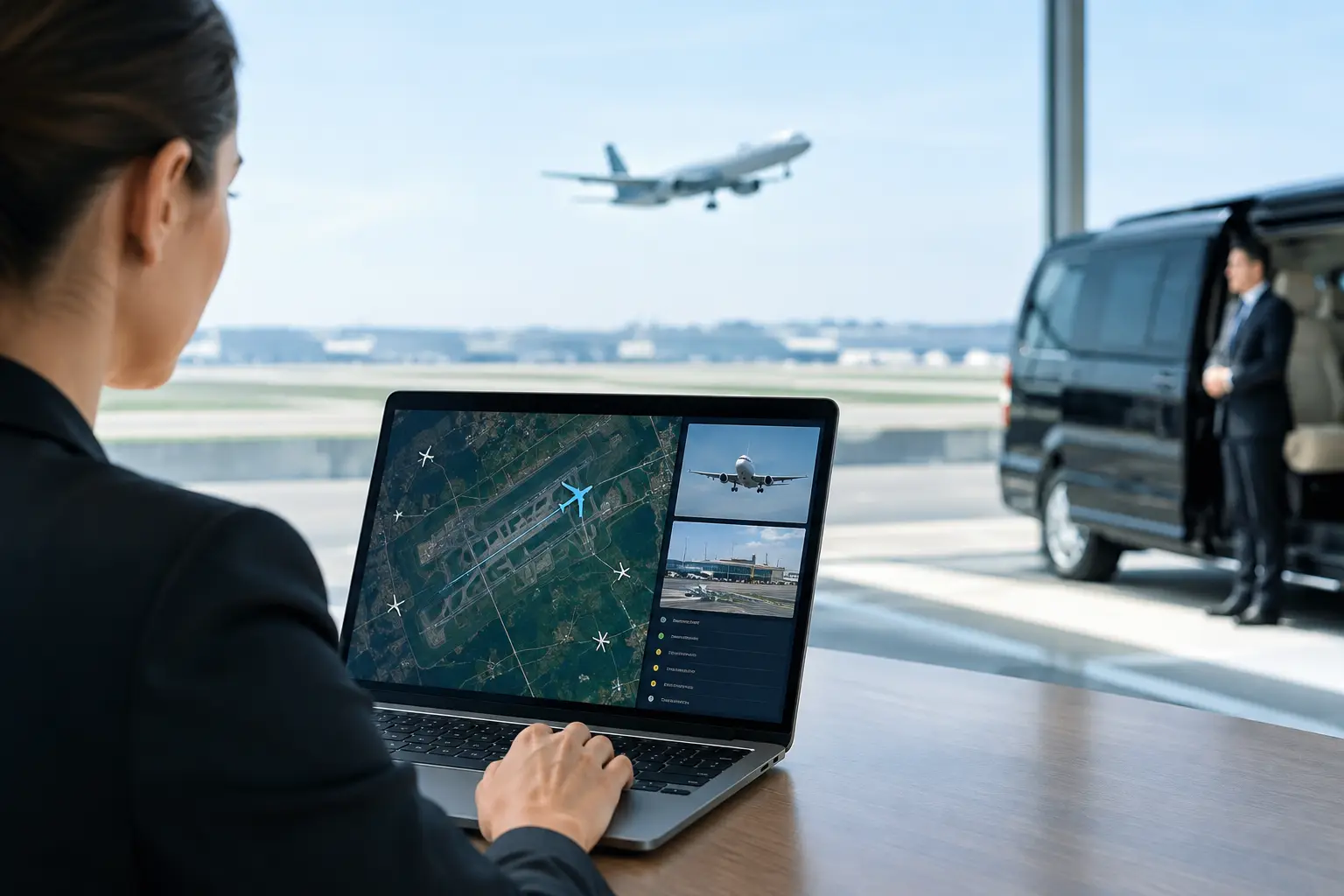
A delayed flight should not mean landing at Newcastle, Manchester or Leeds Bradford and wondering whether your driver has given up and gone home. That is the practical value of knowing how flight monitoring works. For a pre-booked airport transfer, it gives your chauffeur the information needed to adjust their arrival around your actual flight, rather than the timetable you hoped to keep.
It is a simple idea, but good flight monitoring is more than watching a plane move across a map. It combines live flight information with local knowledge, sensible driver planning and clear communication, so your onward journey still feels organised when air travel does not go exactly to plan.
How flight monitoring works before you land
When you book an airport collection, the most useful detail you can provide is your flight number, alongside the date, airport and terminal where possible. A flight number is far more reliable than an expected landing time alone. Timetables can change, while the flight number allows a chauffeur service to follow the progress of that specific inbound service.
Flight monitoring systems use data supplied by airlines, airports and aviation tracking services. This information can show whether a flight has departed, is running behind schedule, has been diverted, has landed or has had its estimated arrival time revised. It helps the transport team plan the collection around the latest available information rather than relying on a booking made weeks earlier.
For example, a passenger flying from Alicante to Newcastle may have booked their transfer based on a 19:30 arrival. If departure is delayed and the latest estimate moves to 21:00, the driver can revise their approach to the airport. The aim is to be ready for the passenger's real arrival, not to charge in early and leave them concerned about an unnecessary wait.
This is particularly helpful on evening arrivals, during poor weather and for long-haul journeys where delays are more likely. It also matters for business travellers whose schedule may be tight, and for families arriving with tired children, pushchairs and several cases. Nobody wants the final part of the journey to involve chasing updates from an unfamiliar terminal.
Landing time is not collection time
One of the most common misunderstandings is that a plane touching down means the passenger is ready to leave. In reality, landing is only the start of the airport process.
After touchdown, the aircraft may taxi for several minutes before reaching its stand. Passengers then disembark, walk through the terminal, collect hold luggage and, on international arrivals, pass through passport control. The time involved varies considerably. A domestic traveller with hand luggage may be outside quickly; a full international flight arriving at a busy time may take much longer.
That is why a well-managed airport transfer does not simply place a driver at the kerb the moment an aircraft lands. The driver and office team allow for the airport itself, the terminal layout and the type of arrival. They also keep an eye on updates rather than treating the first estimated time as final.
Meet-and-greet arrangements need the same care. If your driver is meeting you in the arrivals hall, they must time their entry and parking appropriately. If they are collecting you from a designated pick-up point, they need to account for airport access rules and waiting restrictions. The flight data informs the plan, but the service around it is what makes the collection feel smooth.
What a chauffeur does with live flight updates
Live updates allow the driver to make practical decisions throughout the journey to the airport. They may adjust the time they set off, choose when to enter the airport area or hold nearby until the timing is right. This protects punctuality while avoiding the frustration of arriving excessively early and being caught by airport waiting limits.
For the passenger, the key benefit is reassurance. You do not need to spend the flight worrying that a delay has left your transfer arrangement out of date. A professional chauffeur will still plan carefully around your booking, luggage requirements and agreed meeting point.
There are limits, however. Flight monitoring can show that an aircraft has landed, but it cannot always tell a driver exactly how long passport control or baggage reclaim will take for one passenger. It may not immediately reflect a late gate change, a lost bag or a traveller who stops to make a call before leaving the terminal. That is why communication still matters.
If you can, keep your phone switched on after landing and send a brief message if something changes at your end. A quick update such as ‘still waiting for bags’ or ‘through passport control now’ can help the driver fine-tune the final few minutes. For a meet-and-greet booking, follow the collection instructions you have been given rather than rushing to a different exit.
Why the flight number matters so much
Providing the correct flight number is the difference between useful monitoring and guesswork. Airports handle numerous arrivals close together, often from the same city or airline. A scheduled time alone does not always identify the flight accurately, especially if there is a last-minute timetable change.
Check the flight number on your airline confirmation before travelling. It is usually a short airline code followed by numbers. If you are on a connecting flight, give the final flight that arrives at the collection airport, not the service that begins your journey. For instance, if you travel via Amsterdam before landing at Newcastle, the Newcastle-bound flight is the one your chauffeur needs to monitor.
It is also worth telling the provider if your airline changes the flight number, airport or terminal. Airlines occasionally consolidate services, rebook passengers or alter schedules at short notice. Monitoring works best when the booking information matches the journey you are actually taking.
Flight monitoring is not a substitute for planning
A good service starts long before the aircraft is airborne. Your chauffeur company should know how many passengers are travelling, the number and type of bags, whether a child seat is needed and the final destination. These details determine the right vehicle and prevent an awkward start to the journey home.
For a couple returning with cabin bags, an executive saloon may be ideal. For a family with large suitcases, golf clubs or a pram, a spacious Mercedes-Benz V-Class or minibus may be the better choice. Flight monitoring helps get the timing right; suitable vehicle planning makes the journey comfortable once you are collected.
The same applies to the route home. Roadworks, major events and poor weather can affect the roads just as a delay affects the air. An experienced local chauffeur factors in the journey from the airport to Teesside or the wider North East, rather than viewing airport collection as a single fixed moment.
The difference between tracking a flight and looking after a passenger
Anyone can check a public arrivals board. The value of a pre-booked airport transfer lies in what happens next. Someone takes responsibility for turning live information into a sensible, personal collection plan.
That means knowing when to adjust without making the customer chase for answers. It means allowing enough time for arrivals procedures, being clear about where to meet and having a clean, appropriate vehicle ready for the number of people and bags booked. For corporate guests, it also means a discreet, professional welcome that reflects well on the company arranging the travel.
At AL Executive, flight monitoring sits alongside fixed upfront pricing, dedicated chauffeurs and meet-and-greet support. The focus is not merely on following a flight, but on making sure the person on that flight has a dependable onward journey.
When you book your next airport collection, share the flight number, keep your phone available after landing and choose a service that plans around the whole journey. Then, even if your arrival time changes, getting home, to your hotel or to the office can remain the straightforward part of the day.